Another post about herbalism, incredibly.
Kurt Vonnegut's 'Slaughterhouse Five', mentioned the other day, has a bit in it where the main character, Billy Pilgrim, is suffering from severe malnutrition and working in a factory which makes multivitamin syrup. This being the Second World War, anyone in the factory who consumes the syrup will face the death penalty, so he restrains himself even though everyone else is doing it. On the second day, he succumbs and, and I paraphrase, every cell in his body lets out a round of applause.
There are plenty of biological drives like this, such as the urge to breathe, quench your thirst and sate your hunger, and this last one is probably closest to the urge to take a herbal remedy for me.
This morning, I was dispensing some of this stuff:
This is 1:5 tincture of Vaccinium myrtillus, also known rather vaguely as bilberry or blueberry although it's only one of several related species of the fruit, native to the Old and New Worlds.
I'm currently holding it in my mouth. It has a vague sweetness to it with a note of astringency, and it will shortly flow down my throat. There it goes. It has a pleasant aftertaste and is in fact, to me right now, rather moreish (though not that moreish).
In normal circumstances, I don't crave bilberry (oh, by the way, here's a botanical illustration of the stuff:
), but this morning I found myself doing so. This is doubtless because there is something in the plant I needed, which wouldn't be surprising as I haven't eaten much fruit other than cucumbers and tomatoes recently, so it'll be the flavonoids, vitamin C, anthocyanins or something. I haven't had this with Vaccinium before though.
When this happens, the experience Kurt Vonnegut describes above follows shortly after. It's hard to describe, but you know it when you feel it. There's also a sense of it being like a jigsaw piece fitting into a puzzle, which in pharmacodynamic (what something does to you) terms is sort of what happens - the various bits of needed stuff slot into the gaps in your body which need them and then you end up being able to do what you need.
Something I've experienced this with more than any other herb is the bitter reaction (which I'm experiencing now as I type about it) from Erythraea centaurium. The bitter reaction seems to be the release of the pancreatic hormone gastrin due to stimulation of the glossopharyngeal nerve by the bitter taste and the consequent stimulation of the vagus nerve (cranial nerves IX and X, which as the numbers suggest are neighbours). Here's a photo of some Erythraea centaurium flowers:
"Centaurium erythraea 220603" by Picture taken by BerndH - Own work. Licensed under Creative Commons Attribution-Share Alike 3.0 via Wikimedia Commons - http://commons.wikimedia.org/wiki/File:Centaurium_erythraea_220603.jpg#mediaviewer/File:Centaurium_erythraea_220603.jpg
This stuff was clearly something I needed. It was of course a liver tonic, and I have had Gilbert's Syndrome, which is like IBS for jaundice instead of the bowels, so probably that was why. However, with certain herbs you don't need to take the actual herbal remedy itself to get the action, and bitters are a particularly good example of this. When I was thinking about this herb earlier, I had the taste in mind and I could feel it making my mouth water. This is because simply thinking about the taste stimulates the release of gastrin in the same way as the actual taste does.
There are at least two other taste reflexes, I would say, and in fact I would say that probably every taste has its response. One is the sour reflex stimulated by vinegar, which does things like cause coughing, and another is apparently the sweet reflex. There's a strong tendency for sweet substances without useful calories to lower blood sugar, and this makes sense as the sweet taste is often associated with the consumption of sugar so it would seem to be a signal for the body to start storing glucose and getting it out of the bloodstream to make room for more and prevent, for instance, fluid loss by diuresis, which is what happens when substances rises above certain levels in the plasma.
Cravings, however, can also fool you as they can be addictions to harmful substances. This happens all the time with carbohydrates for many people, although for me I am for some reason averse to sugar and sweet-tasting food, a phenomenon my brother refers to as "not liking nice stuff".
Of course I'm going to have to shoehorn this in. The ultimate cellular applause moment I experience is when I consume a phytoestrogen, and of course this works whether or not I know I'm doing it. That's just on another level entirely, and presumably the same happens when an F2M gets testosterone.
Leaving that aside though, because I must be boring you all senseless, one of the rather tricky tasks a herbalist has to do is to flip this round. Just as sympathy symptoms are reflected in the practitioner's own body, and in my case I do mean reflected as they occur on the opposite side of my body than the patient's on most occasions, the cravings could be too, and if those cravings are therapeutic rather than addictions, you then have to try to get yourself mentally into a position where you crave what they crave, and then distinguish between the helpful and unhelpful cravings.
That's the peculiar job of the herbalist, or part of it.
Saturday, 6 December 2014
Friday, 5 December 2014
About Left Unity
Left Unity is a political party which aims to get back to the "spirit of '45", i.e. the kind of approach taken by the Labour government elected just after the Second World War, which established the NHS among other things. It's called Left Unity because it aims to avoid the kind of splits which beset the Left, leading to, as it were, turbulence rather than laminar flow. I'm not going into my actual political beliefs in this respect but suffice it to say that the approach taken by Left Unity is substantially compatible with what I want for society in this country. That doesn't make me left wing but I don't want to go into that right now. Also, Sarada is standing for a post in Left Unity and as her partner, I would like her to win, even though she might get a lot of flack in that position.
You might think that because I support the aims of Left Unity I would be a member. After all, in my time I've been a member of CND, the Green Party, Education Otherwise, the Church of England, Friends of the Earth, various animal liberation groups and so forth, because I was prepared to compromise my principles enough in order to work with other people together for a common aim. However, I have no plans to join Left Unity, and there are two reasons for this. Someone might come along and tell you what one of them is but I won't be doing that. I want to concentrate on the other reason.
On their website, Left Unity describe themselves as " a new kind of party, with feminism, socialism, environmentalism and anti-racism at its heart." I think you can probably see where I'm going to go with this already.
A member of Left Unity would, I hope, see themselves as anti-racist, environmentalist, socialist and feminist. I am in fact anarchist but that's not necessarily a barrier to working with socialists, any more than socialists and fundamentalist Christians can't work together against Sunday trading. They can forget their differences and unite to ensure people are not forced to do paid work on a holiday, and in fact this has been done in the past. I also hope I'm anti-racist, although of course I am inevitably racist as that's ineradicable due to my white privilege. That does of course mean that I will fail to understand or have an intuitive or informed feel for many issues involving ethnicity. Environmentalism is also something I can get wholeheartedly behind, although the word strikes me as a little insipid. I used to see myself as deep Green, and for me the word "environmentalist" calls to mind things like conservation organisations which offer free turkey dinners in Xmas raffles, mentioning no names.
There was a wildlife campaigner in South Africa who once drove over some giant tortoise shells on display outside someone's house who was trying to sell them in order to stop them profiting from killing. They were of course poached. However, at the time the only person at home in the house was not the person running the business but his wife. This may not have happened, but I can easily imagine his wife becoming the victim of domestic violence as a result of that incident. This is probably something the campaigner didn't think about, or he may have thought that since she was living off those profits (which is another assumption) she deserved to get beaten up by her husband. The consequences of that incident are of course all in my imagination, and I may have got it wrong. I am probably making assumptions of my own about this.
Therefore, this guy, I'm going to say, was environmentalist but not feminist, and not pro-feminist, and the reason I'm assuming he wasn't pro-feminist is that he did not seem to be concerned about the woman's welfare or even aware of the probable (probability meaning rational degree of belief) consequences of destroying the bits of murdered animals because of her being a woman. Notice this however: I am also making possibly sexist assumptions about her. She may have been the business owner. She may have been adequately able to defend herself against her husband. Or she may have been the dominant partner in the marriage. Therefore I'm being sexist.
Back to Left Unity. It has described itself as a feminist party. This immediately and rightly excludes me, because I cannot be a feminist. I can be pro-feminist of course, but look at the assumptions I may have just made. It's a deficiency to me that however strongly I may have resisted and however reluctantly I was forced to comply with a gender of which I had no wish to be a part, I have been socialised as male and I have benefited from male privilege even if I may have suffered from being on the wrong side of cisgender privilege (which obviously exists by the way). It's also true that one can work with a group without being part of that group and that being trans might give me insights and the ability to contribute from a new angle which could in itself be liberating for all involved. However, the fact remains that most women are ciswomen, meaning that the single largest oppressed group in society, and therefore the most important, is ciswomen.
I could also work with feminists, in theory, and I probably do. When I do that, I will unwittingly be working against liberation because of what I am - a male-socialised person. It is completely impossible for me to help actively. An example might be that I would tend to interrupt people more than a ciswoman does, or be more prepared to change the subject in a discussion. There will be a host of other things that I will do which are unhelpful and "counter-revolutionary".
Therefore, I will not join Left Unity because I have no place in it. This is not a negative thing, because I have a vision, which will doubtless never be realised, or Left Unity as a ciswoman-only party, i.e. a properly feminist one, which works together properly rather than divisively, understands the issues from direct experience of being oppressed by them and has a proper class-consciousness as members of the female gender due to its universal Geworfenheit.
You may disagree of course, and say that a women-only party would be half the potential size and therefore less effective. It might well be half the size but that doesn't mean it will only be half as effective. The point is that although there would be some internalised misogyny in such a party, I'd be prepared to bet that it would be a lot less sexist in its operation and policies than a party which has either men or transwomen in it. I find the idea of a women-only socialist party very encouraging, exciting and positive. I would also expect it to be more effective for the lack of patriarchal baggage in it, although of course it wouldn't be entirely absent.
Therefore, there are two reasons why I won't be joining Left Unity, and this is one of them. I will mention the other one if you exhort me to join, and I'm not playing games here, I just don't want that kind of attention, believe it or not. Anyway, happily all three of the candidates for speaker are socialised as women and will therefore have less false consciousness and unhelpful behaviour, so that's all good. Obviously I'd like Sarada to win - that's the patriarchal distortion in my own consciousness brought on by the disgusting institution of marriage though, so feel free to ignore it except as an illustration of how insidious sexism is.
You might think that because I support the aims of Left Unity I would be a member. After all, in my time I've been a member of CND, the Green Party, Education Otherwise, the Church of England, Friends of the Earth, various animal liberation groups and so forth, because I was prepared to compromise my principles enough in order to work with other people together for a common aim. However, I have no plans to join Left Unity, and there are two reasons for this. Someone might come along and tell you what one of them is but I won't be doing that. I want to concentrate on the other reason.
On their website, Left Unity describe themselves as " a new kind of party, with feminism, socialism, environmentalism and anti-racism at its heart." I think you can probably see where I'm going to go with this already.
A member of Left Unity would, I hope, see themselves as anti-racist, environmentalist, socialist and feminist. I am in fact anarchist but that's not necessarily a barrier to working with socialists, any more than socialists and fundamentalist Christians can't work together against Sunday trading. They can forget their differences and unite to ensure people are not forced to do paid work on a holiday, and in fact this has been done in the past. I also hope I'm anti-racist, although of course I am inevitably racist as that's ineradicable due to my white privilege. That does of course mean that I will fail to understand or have an intuitive or informed feel for many issues involving ethnicity. Environmentalism is also something I can get wholeheartedly behind, although the word strikes me as a little insipid. I used to see myself as deep Green, and for me the word "environmentalist" calls to mind things like conservation organisations which offer free turkey dinners in Xmas raffles, mentioning no names.
There was a wildlife campaigner in South Africa who once drove over some giant tortoise shells on display outside someone's house who was trying to sell them in order to stop them profiting from killing. They were of course poached. However, at the time the only person at home in the house was not the person running the business but his wife. This may not have happened, but I can easily imagine his wife becoming the victim of domestic violence as a result of that incident. This is probably something the campaigner didn't think about, or he may have thought that since she was living off those profits (which is another assumption) she deserved to get beaten up by her husband. The consequences of that incident are of course all in my imagination, and I may have got it wrong. I am probably making assumptions of my own about this.
Therefore, this guy, I'm going to say, was environmentalist but not feminist, and not pro-feminist, and the reason I'm assuming he wasn't pro-feminist is that he did not seem to be concerned about the woman's welfare or even aware of the probable (probability meaning rational degree of belief) consequences of destroying the bits of murdered animals because of her being a woman. Notice this however: I am also making possibly sexist assumptions about her. She may have been the business owner. She may have been adequately able to defend herself against her husband. Or she may have been the dominant partner in the marriage. Therefore I'm being sexist.
Back to Left Unity. It has described itself as a feminist party. This immediately and rightly excludes me, because I cannot be a feminist. I can be pro-feminist of course, but look at the assumptions I may have just made. It's a deficiency to me that however strongly I may have resisted and however reluctantly I was forced to comply with a gender of which I had no wish to be a part, I have been socialised as male and I have benefited from male privilege even if I may have suffered from being on the wrong side of cisgender privilege (which obviously exists by the way). It's also true that one can work with a group without being part of that group and that being trans might give me insights and the ability to contribute from a new angle which could in itself be liberating for all involved. However, the fact remains that most women are ciswomen, meaning that the single largest oppressed group in society, and therefore the most important, is ciswomen.
I could also work with feminists, in theory, and I probably do. When I do that, I will unwittingly be working against liberation because of what I am - a male-socialised person. It is completely impossible for me to help actively. An example might be that I would tend to interrupt people more than a ciswoman does, or be more prepared to change the subject in a discussion. There will be a host of other things that I will do which are unhelpful and "counter-revolutionary".
Therefore, I will not join Left Unity because I have no place in it. This is not a negative thing, because I have a vision, which will doubtless never be realised, or Left Unity as a ciswoman-only party, i.e. a properly feminist one, which works together properly rather than divisively, understands the issues from direct experience of being oppressed by them and has a proper class-consciousness as members of the female gender due to its universal Geworfenheit.
You may disagree of course, and say that a women-only party would be half the potential size and therefore less effective. It might well be half the size but that doesn't mean it will only be half as effective. The point is that although there would be some internalised misogyny in such a party, I'd be prepared to bet that it would be a lot less sexist in its operation and policies than a party which has either men or transwomen in it. I find the idea of a women-only socialist party very encouraging, exciting and positive. I would also expect it to be more effective for the lack of patriarchal baggage in it, although of course it wouldn't be entirely absent.
Therefore, there are two reasons why I won't be joining Left Unity, and this is one of them. I will mention the other one if you exhort me to join, and I'm not playing games here, I just don't want that kind of attention, believe it or not. Anyway, happily all three of the candidates for speaker are socialised as women and will therefore have less false consciousness and unhelpful behaviour, so that's all good. Obviously I'd like Sarada to win - that's the patriarchal distortion in my own consciousness brought on by the disgusting institution of marriage though, so feel free to ignore it except as an illustration of how insidious sexism is.
Thursday, 4 December 2014
Avoiding Solutions
Believe it or not, this post is sort of about herbalism! But only sort of, naturally.
Audrey Niffenegger is best known as the author of 'The Time Traveler's Wife', a book whose plot is irritatingly similar to that of Kurt Vonnegut's 'Slaughterhouse Five', but of course because Vonnegut is a mere science fiction author, he doesn't count even though he published it in 1962 and Niffenegger didn't publish her novel until 2003. This is because literary fiction is not a genre, oh no, I mean how could it be? After all it's read by real people rather than nerds.
Obviously there are about to be spoilers but this is literary fiction, which is essentially unspoilable.
Leaving that aside though, she did write a rather less annoying book called 'Her Fearful Symmetry', which I may have mentioned before. It's an enjoyable read and also an interesting one, though somewhat nerdy about Highgate Cemetery and I feel the clothing choices of the central character(s) would be rather impractical because of their ghostly colour (aha!). One thing which really sticks in my mind about it is the germ-phobic character, who at one point points out that part of his condition is not wanting treatment for his condition. In his view, if he was treated he would become unhygienic, suffer an infection and die. This applies more widely of course, and in order not to annoy people, I will start by referring to myself, which come to think of it is annoying in a different way, but anyway: I didn't want treatment for my condition, because that was part of the condition. My idiosyncrasies, and I am aware that many of them are still in place, felt like part of my identity although they seem now to have been coping mechanisms. Incidentally, there is one piece of clothing neuroticism left - I still don't like tops with fastenings that only go part of the way down. That seems to be all though. I don't know why that's still in place.
Extending this, I need now to be careful not to turn into Oliver Sacks and plunder confidential notes for interesting stories, but I can be more general and offer a couple of slightly altered examples. A patient has a recurring acute condition. I look at her lifestyle and am dismayed, as I often am, that she seems to be doing everything right. Then I question her further and find there is one thing she isn't doing right: she is a habitual user of aspartame. Aspartame is the compound which almost laid me out in 2004. Nor is this junk science. Nonetheless she was very keen on making any changes other than that single change which I believe would have eliminated her condition. She didn't even want to switch to saccharin. Therefore her condition persisted, although I was able to help her a bit. At no point did she seem fully conscious that that was the culprit, which is particularly interesting. I did tell her what I thought was going on.
Another situation: a patient has a fairly serious physical condition with major affective components - she is depressed and anxious. Small measures which would probably relieve it are avoided. Also, every herbal remedy she is prescribed leads to an adverse reaction even when the remedies involved are also ingested in the same or higher doses as culinary herbs in her regular diet.
These examples have been altered in insignificant ways to protect the innocent of course. I needn't do the same for myself. As I was writing my "autobiography" (yes, it is that colour because of the ink running out on the printer), I realised I've been doing this all my life. I still have no idea if the clinic is going to take me seriously or agree with me, but that in itself is a valuable insight.
Sometimes people will do almost anything rather than get well, and I am sometimes people.
Audrey Niffenegger is best known as the author of 'The Time Traveler's Wife', a book whose plot is irritatingly similar to that of Kurt Vonnegut's 'Slaughterhouse Five', but of course because Vonnegut is a mere science fiction author, he doesn't count even though he published it in 1962 and Niffenegger didn't publish her novel until 2003. This is because literary fiction is not a genre, oh no, I mean how could it be? After all it's read by real people rather than nerds.
Obviously there are about to be spoilers but this is literary fiction, which is essentially unspoilable.
Leaving that aside though, she did write a rather less annoying book called 'Her Fearful Symmetry', which I may have mentioned before. It's an enjoyable read and also an interesting one, though somewhat nerdy about Highgate Cemetery and I feel the clothing choices of the central character(s) would be rather impractical because of their ghostly colour (aha!). One thing which really sticks in my mind about it is the germ-phobic character, who at one point points out that part of his condition is not wanting treatment for his condition. In his view, if he was treated he would become unhygienic, suffer an infection and die. This applies more widely of course, and in order not to annoy people, I will start by referring to myself, which come to think of it is annoying in a different way, but anyway: I didn't want treatment for my condition, because that was part of the condition. My idiosyncrasies, and I am aware that many of them are still in place, felt like part of my identity although they seem now to have been coping mechanisms. Incidentally, there is one piece of clothing neuroticism left - I still don't like tops with fastenings that only go part of the way down. That seems to be all though. I don't know why that's still in place.
Extending this, I need now to be careful not to turn into Oliver Sacks and plunder confidential notes for interesting stories, but I can be more general and offer a couple of slightly altered examples. A patient has a recurring acute condition. I look at her lifestyle and am dismayed, as I often am, that she seems to be doing everything right. Then I question her further and find there is one thing she isn't doing right: she is a habitual user of aspartame. Aspartame is the compound which almost laid me out in 2004. Nor is this junk science. Nonetheless she was very keen on making any changes other than that single change which I believe would have eliminated her condition. She didn't even want to switch to saccharin. Therefore her condition persisted, although I was able to help her a bit. At no point did she seem fully conscious that that was the culprit, which is particularly interesting. I did tell her what I thought was going on.
Another situation: a patient has a fairly serious physical condition with major affective components - she is depressed and anxious. Small measures which would probably relieve it are avoided. Also, every herbal remedy she is prescribed leads to an adverse reaction even when the remedies involved are also ingested in the same or higher doses as culinary herbs in her regular diet.
These examples have been altered in insignificant ways to protect the innocent of course. I needn't do the same for myself. As I was writing my "autobiography" (yes, it is that colour because of the ink running out on the printer), I realised I've been doing this all my life. I still have no idea if the clinic is going to take me seriously or agree with me, but that in itself is a valuable insight.
Sometimes people will do almost anything rather than get well, and I am sometimes people.
Wednesday, 3 December 2014
Ear Piercing Shriek
A few months ago the young and hygienic Chloë made me feel very old in the Lathe of Hedonia by making holes in my ears, for which I had bartered the generous and marvellous Vanilla Rose some herbs so that I could avail myself of their services. This was all very very good. As the needles went through my earlobes, for the first time I experienced matter passing completely through me, entering and exiting, over a period of less than a few minutes, and in my mind's eye I saw an image resembling Dali's Soft Self-Portrait as it happened. I ended up with two of these, although I don't normally think of them this blurrily:
You try taking a photo of the side of your head while sitting here and see if you do any better.
I did of course have an ulterior motive in undergoing the piercings, but the less said about that the better. I found them ludicrously easy to maintain, which was part of the experiment of course. This was now well over thirteen weeks ago and it was problematically unproblematic.
That period, which is apparently a lot longer than anyone was expecting or than necessary, is now past, so last week I went out and bought a pair of these:
You will note from this photograph that far from being inserted in my earlobe, this earring is still on the card it was on when I bought it. The reason for this is that I have so far been completely incapable of removing the sleeper from my ear. I'm sure there's a really simple thing I'm missing here but have no idea what it is. It's clearly supposed to unscrew but it just goes round and round and won't come apart. So anyone, what's going on and how do I get it out?
There you go: bet you weren't expecting a blog post like this were you?
You try taking a photo of the side of your head while sitting here and see if you do any better.
I did of course have an ulterior motive in undergoing the piercings, but the less said about that the better. I found them ludicrously easy to maintain, which was part of the experiment of course. This was now well over thirteen weeks ago and it was problematically unproblematic.
That period, which is apparently a lot longer than anyone was expecting or than necessary, is now past, so last week I went out and bought a pair of these:
You will note from this photograph that far from being inserted in my earlobe, this earring is still on the card it was on when I bought it. The reason for this is that I have so far been completely incapable of removing the sleeper from my ear. I'm sure there's a really simple thing I'm missing here but have no idea what it is. It's clearly supposed to unscrew but it just goes round and round and won't come apart. So anyone, what's going on and how do I get it out?
There you go: bet you weren't expecting a blog post like this were you?
Tuesday, 2 December 2014
Anti-Language
Recently I've been thinking a lot about how I communicate because it really bothers me. It's been a while since I started feeling bothered by that actually. People used to understand me easily but since I went to Warwick I seem to have lost the ability to be clear and even though it's been a long time, it's never come back. It might be down to the people with whom I communicate, but I think it's more than that. Having said that, I remember a cartoon in the school newsletter which parodied the way I talked back then, and it was really quite similar, so maybe I've just imagined it.
Take what I wrote yesterday as an example. Sarada got annoyed by it because she felt me writing words in Hebrew would make it harder to understand. I know quite a few people who know a bit of Hebrew, but I understand what she's saying. Sarada is very focussed on what she sees as me failing to come across clearly and tends to look at my writing in those terms more than any other. This feels to me like she's ignoring the content, but of course she isn't. What she is doing is ignoring the plain meaning of the writing. Another issue we have with this is that we are the only two people talking about it at the time, so it could be folie à deux and we'd never know. What I mean is, the two of us could both be wrong, or we could both be pulled into a habit of relating to each other which bears no relation to how other people see it. She says this isn't so because she knows what other people are like, but to that I would say that knowing what other people are like would be magic, and nobody can really do that. I used Hebrew because I liked its look, and also because in 'Unspeakable', the windows of the space ark spell out its name in the language. I didn't share this with you then, so it's information I'm hoarding in a way, as is writing it in Hebrew, which is the first problem: we can talk to hide what we know.
When we do hide what we know, we might be doing it for all sorts of reasons. Sometimes we might be ashamed or guilty, or be afraid of being rejected by people. Sometimes we might upset people if we said it. Other times, we could be trying to dumb ourselves down, or maybe so much in the habit of doing that that we don't even notice it any more, because we're afraid of how we might be treated if people thought we were trying to be clever, or were actually being clever. When we do all of those things, we are submitting to people. The people listening to us have got the upper hand. You might find this surprising, because I'm not very good at it probably, but I actually dumb myself down a lot. When I say "I'm not very good at it", I don't mean I'm really smart. What I mean is that I have so internalised my need to do the things I'm about to mention that I find it hard to step out of it, so you all get "clever-clever" Mands all the time even though I don't really want you to think of me like that. I want you to think of me as nice and approachable.
Let's move on to the much nastier reason for doing things that way which I am afraid is my real reason. I wrote a couple of Hebrew words in there because I like the way Hebrew looks, and I wanted to share that with you. I'm ashamed that there's another reason and you just have to accept that I am trying really hard to stop doing this because I hate that I do it, but it is really difficult not to do it. I do that kind of thing habitually because, and this is embarrassing, it's left over from what I think of as a masculine style of speech, the "mainsplaining" thing. Mainsplaining has all sorts of stuff in it, but for me, one of the big things I do when I'm doing that is that I'm using words to hoard knowledge and keep it from you so you all end up thinking I'm better than you in some way. I really wish I wouldn't do that, but the thing is, I've never been pretty, strong or good at anything else very much, so it's all I've got. What you're seeing when I do this, surprisingly, is my inner child who wants your attention.
It's anti-language. The words I use at you are not supposed to help you do anything, and I'm not trying to share anything with you because if I did, you'd be more powerful and I'd be weaker, because then you'd know what I know. Also, look at what I've done here. Someone got an apology card from me a few weeks ago where I said sorry for not helping her, but did I actually help her? No, I just sent her an apology card instead, because that's what I do. It's always all about me, and I don't want it to be, but somehow it always ends up that way and I'm sorry. And there I go again, but I am trying to stop doing it, honestly.
When Lazarus Zamenhoff invented Esperanto, he wanted people all over the world to understand each other. What actually happened was that if you really want to make sure nobody understands you, your best bet is to talk in Esperanto. It's the ultimate anti-language. Even so, when people use anti-language, they are really communicating. It's just that they're not saying what they seem to be saying, whatever that is. When we use English, we have a built-in way of hoarding information because our legendary class system is built into the language. We have word-hoard and we have vocabulary, which ironically contain the opposite of what they say. The words we use to hoard information (equals knowledge (sometimes), equals power) are the ones from French and Latin, mainly. If I compose a sentence with a plethora of pretentious verbiage in it, the probability of comprehension is minuscule, and that's because the posh people spoke French and it means the powerful people keep the power. That's word-hoarding. The words "word-hoard", funnily enough, are English and not French or Latin. When we don't hoard words, we often speak to each other using the older bits of English, that is, the bits which were already here before William came over the water, and when we do that, folk get what we're saying.
We do things with words. When we say "fancy a cuppa?" we aren't just asking someone if they would like a cup of tea or even offering them a cup of tea. We're trying to make them feel welcome. When on the other hand someone says "do you like hospital food?", they probably aren't trying to make them feel welcome at all. This is really obvious of course.
What I want to do is move from the way of using language which I despise myself for, that lot up there, to the other side - I want to talk to you "all" in a way which puts you at your ease, cheers you up and makes you feel listened to and cared about. It might be that this side of things is the "pink" side, but that's not why I want to do it. I want to be on that side because to me, and I know you may disagree with me but I'm trying to tell you why I'm doing this, I want to care and I want to be a good person. I don't actually care about clever and funny at all. I care about clever and funny if it helps, but I despise myself for my self-aggrandisement and pulling everyone else into my well.
I really hope that has come across to you. I expect it hasn't though because I'm awful at that. Now what am I doing there?
See? I just can't do it. FML eh?
Monday, 1 December 2014
It Will Always Be With Us
I had a bit of a disagreement yesterday which was partly down to me, partly down to the nature of the medium used and partly down to other stuff. It was basically that someone got annoyed because she thought I'd said that everyone was either a narcissist or religious, which isn't what I meant. I don't want to go into this now, but I do want to mention something else which I think is problematic.
I have at different times been religious and very opposed to religion. Sometimes I've even been both at the same time. It is in fact very easy indeed to be against religion and I sometimes surprise myself at how I'm not. There was a twelve-year period during which I thought Christianity, and more specifically St Paul, was the worst thing to happen to this planet since the extinction of the dinosaurs. That is, it was responsible for the culture which was causing the current mass extinction, so it was about as good as a rock the size of the Isle of Wight hitting us and twenty miles a second or something. I wasn't keen on it at all. Earlier in my life I'd been about equally unkeen on Islam mainly due to its misogyny. In the end, of course, I came round, and this is something people don't understand and which I'm not going to explain right now. Circumstances may change in such a way that I will be put in a position where it would be OK to explain, but they have yet to arise and I don't particularly want them to, so some of that is just going to have to stay mysterious.
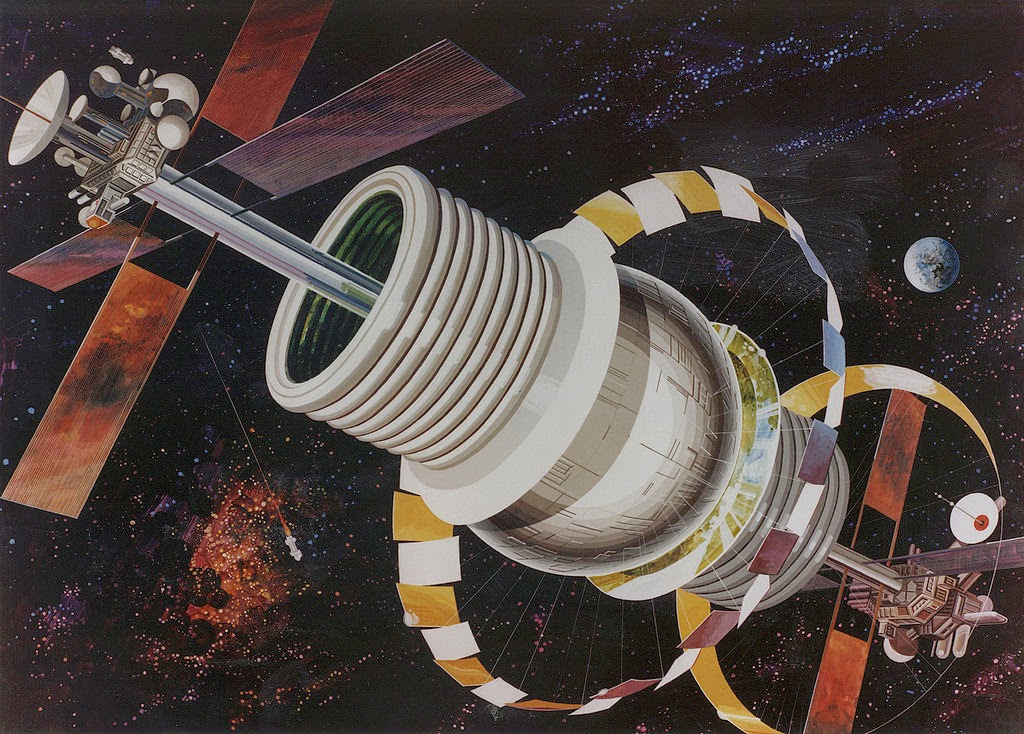
Nevertheless, and I have to admit I'm getting a sense of déjà vu here and I reckon you'll find another blog entry or vlog of mine on this somewhere, I think that all of that misses the point. It could be argued that people getting cancer or killed in earthquakes is not a good thing, and consequently one might wish to avoid carcinogens or fault zones, but the latter at least is hard to eliminate and will be a risk on this planet for billions of years to come. All you can do is avoid them, perhaps by building one of these:
Credit: NASA - will be removed on request.
So there is a technical solution to that. However, the people living in that thing would probably be talking or signing to each other, singing songs and listening to music, possibly wearing jewellery and the like. They will be partaking of, in other words, cultural universals.
In 'Unspeakable', my recently drafted novel, Su boards a space ark, the יָפֶֿתֿ נָשִׁים (geddit?) in the Tau Ceti system heading for Earth. It only takes thirty years to get here. The thing about the Tau Ceti system, and I mean this in reality, is that it is cluttered with debris, so if you pilot a spaceship through it you are likely to get clonked in a mass-extincty stylee and be dead a lot. I would think this would quite worry people, and they might take precautions against it but it might not be totally preventable and there would be a risk. Right now, the inhabitants of a space ark entering the Tau Ceti system might pray, if they believed in God. It might not work, of course, but they might feel better until a space pebble wangs them, all the air leaves and they suffocate, and presumably while all the air is leaving and they're suffocating, they might get around to doing a bit of praying then too, and if they do that rather than try to plug the hole, well, maybe natural selection might remove the gullibility gene that way. However, this book is of course not generally set in the present day and the people living on the יָפֶֿתֿ נָשִׁים aren't religious (incidentally, can someone tell me if I've got that the right way round please?). Or are they? They believe that if anyone on board says "יָפֶֿתֿ נָשִׁים", the ark will get hit by an asteroid and everyone will die. This is because I see that kind of thing as a cultural universal. Every society will develop something like that in the end, and, and this is the crucial point, it doesn't matter whether it's true or not because it will just happen. That's what we do, because we're human beings. We think magically. We want to be able to control things and stop bad things from happening, and if we haven't got a technological way of doing that, we will make one up. Sometimes that will be a wheel or a handaxe, but sometimes it will be a magic spell or a prayer, and I think it will always be with us.
It may of course be really, really bad that it's always with us. Someone might have a seriously ill child and not take them to the doctor because they think that reflects a lack of faith, and then their child might die of something which wouldn't have killed her otherwise, or someone might decide that loving members of your own gender sexually needs to be addressed by chopping someone's head off, and that isn't good either. Nonetheless, nor is being killed by an earthquake or cancer, and these are "acts of God" or natural phenomena. Well, in a similar way, religion, ritual, superstition, all those things and more, are also "acts of God", whether or not God exists. They are, I think, ineradicable features of human society. The chances are that sooner or later, you and I, particularly the latter, are likely to acquire an incorrect, superstitious belief and will not have any insight into that fact, because that's how the human mind works, and furthermore, for a lot of people this belief will not be reinforced or even acquired through reason or logic, but through social factors. You might be surrounded by fellow Tories who also believe the unemployed are lazy, fellow Labour party members who also believe kicking the poorest while they're down is an essential step towards a socialist utopia, or fellow late Victorian physicists who believe in the luminiferous aether. The point is not the truth or otherwise of the beliefs, but their socially cohesive power. They make you part of an in-group, or they comfort you, or something else, but they all fulfil a social function.
Nowadays a perpetual motion machines are almost universally considered to be completely impossible. I can remember looking at designs as a child and it seemed like the objections were little quibbles which could be repaired, and maybe they were, but when they were repaired other design "flaws" would become evident, which were not in fact flaws at all but just illustrated the fact that in energy terms, there is no such thing as a free lunch. There will always be a "leak" somewhere which will cause the machine to run down. This is widely accepted and generally appeals to good sense.
However, we also imagine that we can be rational sometimes, or even all of the time, and that societies would be better off that way. Clearly a society where children are not beaten for holding things with their left hands is in that respect better than one where they are, but that society will not be totally rational throughout. There will be another practice or feature somewhere which is not rational.
Therefore, religion in some form will always be with us, and we can't do anything about it. Given that, we need to live with it and stop pretending we don't do it ourselves. Back when I was a metaphysically naturalist atheist, I also thought Homo erectus had had an interstellar civilisation for hundreds of millenia. I no longer believe in that, but I do believe in God instead. It's not how my mind works particularly, just how minds generally work, and how societies work. People gang up and develop beliefs that bind them together and it's an illusion, perhaps even a superstitious one, that they can be eliminated or that you will not have at least one. That's why it's called "religion": it binds people together.
I have at different times been religious and very opposed to religion. Sometimes I've even been both at the same time. It is in fact very easy indeed to be against religion and I sometimes surprise myself at how I'm not. There was a twelve-year period during which I thought Christianity, and more specifically St Paul, was the worst thing to happen to this planet since the extinction of the dinosaurs. That is, it was responsible for the culture which was causing the current mass extinction, so it was about as good as a rock the size of the Isle of Wight hitting us and twenty miles a second or something. I wasn't keen on it at all. Earlier in my life I'd been about equally unkeen on Islam mainly due to its misogyny. In the end, of course, I came round, and this is something people don't understand and which I'm not going to explain right now. Circumstances may change in such a way that I will be put in a position where it would be OK to explain, but they have yet to arise and I don't particularly want them to, so some of that is just going to have to stay mysterious.
Nevertheless, and I have to admit I'm getting a sense of déjà vu here and I reckon you'll find another blog entry or vlog of mine on this somewhere, I think that all of that misses the point. It could be argued that people getting cancer or killed in earthquakes is not a good thing, and consequently one might wish to avoid carcinogens or fault zones, but the latter at least is hard to eliminate and will be a risk on this planet for billions of years to come. All you can do is avoid them, perhaps by building one of these:
Credit: NASA - will be removed on request.
So there is a technical solution to that. However, the people living in that thing would probably be talking or signing to each other, singing songs and listening to music, possibly wearing jewellery and the like. They will be partaking of, in other words, cultural universals.
In 'Unspeakable', my recently drafted novel, Su boards a space ark, the יָפֶֿתֿ נָשִׁים (geddit?) in the Tau Ceti system heading for Earth. It only takes thirty years to get here. The thing about the Tau Ceti system, and I mean this in reality, is that it is cluttered with debris, so if you pilot a spaceship through it you are likely to get clonked in a mass-extincty stylee and be dead a lot. I would think this would quite worry people, and they might take precautions against it but it might not be totally preventable and there would be a risk. Right now, the inhabitants of a space ark entering the Tau Ceti system might pray, if they believed in God. It might not work, of course, but they might feel better until a space pebble wangs them, all the air leaves and they suffocate, and presumably while all the air is leaving and they're suffocating, they might get around to doing a bit of praying then too, and if they do that rather than try to plug the hole, well, maybe natural selection might remove the gullibility gene that way. However, this book is of course not generally set in the present day and the people living on the יָפֶֿתֿ נָשִׁים aren't religious (incidentally, can someone tell me if I've got that the right way round please?). Or are they? They believe that if anyone on board says "יָפֶֿתֿ נָשִׁים", the ark will get hit by an asteroid and everyone will die. This is because I see that kind of thing as a cultural universal. Every society will develop something like that in the end, and, and this is the crucial point, it doesn't matter whether it's true or not because it will just happen. That's what we do, because we're human beings. We think magically. We want to be able to control things and stop bad things from happening, and if we haven't got a technological way of doing that, we will make one up. Sometimes that will be a wheel or a handaxe, but sometimes it will be a magic spell or a prayer, and I think it will always be with us.
It may of course be really, really bad that it's always with us. Someone might have a seriously ill child and not take them to the doctor because they think that reflects a lack of faith, and then their child might die of something which wouldn't have killed her otherwise, or someone might decide that loving members of your own gender sexually needs to be addressed by chopping someone's head off, and that isn't good either. Nonetheless, nor is being killed by an earthquake or cancer, and these are "acts of God" or natural phenomena. Well, in a similar way, religion, ritual, superstition, all those things and more, are also "acts of God", whether or not God exists. They are, I think, ineradicable features of human society. The chances are that sooner or later, you and I, particularly the latter, are likely to acquire an incorrect, superstitious belief and will not have any insight into that fact, because that's how the human mind works, and furthermore, for a lot of people this belief will not be reinforced or even acquired through reason or logic, but through social factors. You might be surrounded by fellow Tories who also believe the unemployed are lazy, fellow Labour party members who also believe kicking the poorest while they're down is an essential step towards a socialist utopia, or fellow late Victorian physicists who believe in the luminiferous aether. The point is not the truth or otherwise of the beliefs, but their socially cohesive power. They make you part of an in-group, or they comfort you, or something else, but they all fulfil a social function.
Nowadays a perpetual motion machines are almost universally considered to be completely impossible. I can remember looking at designs as a child and it seemed like the objections were little quibbles which could be repaired, and maybe they were, but when they were repaired other design "flaws" would become evident, which were not in fact flaws at all but just illustrated the fact that in energy terms, there is no such thing as a free lunch. There will always be a "leak" somewhere which will cause the machine to run down. This is widely accepted and generally appeals to good sense.
However, we also imagine that we can be rational sometimes, or even all of the time, and that societies would be better off that way. Clearly a society where children are not beaten for holding things with their left hands is in that respect better than one where they are, but that society will not be totally rational throughout. There will be another practice or feature somewhere which is not rational.
Therefore, religion in some form will always be with us, and we can't do anything about it. Given that, we need to live with it and stop pretending we don't do it ourselves. Back when I was a metaphysically naturalist atheist, I also thought Homo erectus had had an interstellar civilisation for hundreds of millenia. I no longer believe in that, but I do believe in God instead. It's not how my mind works particularly, just how minds generally work, and how societies work. People gang up and develop beliefs that bind them together and it's an illusion, perhaps even a superstitious one, that they can be eliminated or that you will not have at least one. That's why it's called "religion": it binds people together.
Sunday, 30 November 2014
Telling Them About You-Know-What
I'm going for chatty here.
The last actual serious NaNoWriMo 2014 write-in happened today. Since I finished on 24th, I used it to go through the draft and start tweaking and in fact there are bits missing, but the majority is there. I need to track the teapot and make sure it doesn't replicate, add a couple of bits of story to glue it together and probably also a few appendices, which people think is weird. I should probably then expose it to critical eyes. My most successful ever story, which I shall refer to as Amanda TBG here and henceforth, was so exposed and that's probably one reason people like it so much.
Speaking of Amanda TBG, and yes that was where my name came from, I'm currently engaged in writing my "autobiography" for the Nottingham clinic. I am really quite nervous about this whole process. The connection is that the subject of Amanda TBG is what I used to refer to as my Problem back when I was a teen, and this is where I get into major difficulties. Firstly, I can't refer to it directly here and of course it is sexual, a paraphilia in fact, but it is neither transvestic fetishism nor autogynephilia. For the uninitiated, transvestic fetishism is getting turned on by wearing "women's" clothes, a category which of course I reject. Incidentally, that tiny handful of people who know the whole "Problem" will realise the irony of me being accused of this, but we're talking inner circle knowledge here.
Look, I am now going to cut the crud and stop playing games. The situation is this. I have had two very unusual sexual kinks. One of them is more widely known to friends, is really bizarre and if I didn't have a sense of humour about it I would probably have tied weights to my bits and thrown them off a bridge quite some time ago. It's completely harmless to everyone else but if I indulged in it properly, it would definitely kill me, so I don't. I can guarantee that whatever you think it is, you're wrong unless I've actually told you. The trouble is this: it is in my opinion supremely relevant to my gender identity issues and could make or break my case for diagnosis and so forth, but of course as well as making it, it could break it, for this reason: people are sometimes seen as autogynephilic or transvestically fetishistic and presumably refused help for that reason, although why is another question because so what if it is a fetish? What that would mean is that a load of transwomen were wandering around enjoying themselves sexually and not being a problem to anyone else because they did things like stay at home all day and play with their boobs instead, so who cares? That sounds not only like a good thing to me, but something which radfems would actually want: "men" who are not rapists. Sounds like a public service to me. Anyway, it's not the case for me, but this paraphilia might be understood in that way, for two reasons. Firstly, it's a transformation paraphilia. Secondly, it resembles something distinctly female. People who know about it always make the connection with my gender issue, and they also see it as distinctly feminine. Also, when I write about it, my text reads like it was written by a woman, whereas this blog entry definitely reads like it was written by a man according to the Gender Genie. Therefore, it's a really high stakes strategy to go in there with all guns blazing and say "I find X a turn on" - they would either be completely convinced by it or completely convinced of the opposite. Of course, it could be that the opposite is what I really need, but it really doesn't seem that way. To me right now, thinking of myself as male feels identical to feeling low self-esteem and thinking of myself as female feels the same as raising my self-esteem, and it really doesn't seem sexual.
The other kink is so rare I can't even find it on the internet. I seem to be genuinely the only person in the world with it, and even I haven't got it any more because the gloop made it go away, which considering the first observation is probably just as well. Nonetheless, after drawing my counsellor a certain diagram, it became clear what it was about and it is also to some extent evidence in favour of a pretty deep problem with gender. It is also deliciously, phenomenally, hugely ironic in a way that makes me want to shout it from the rooftops, but it "should not be told abroad" and I'm not about to share it with anyone. The three people who know about it and what I've done appreciate the intense irony of my situation and I'll have to be content with that. Ah well.
This is what I think happens. Your brain develops structurally as one sex in the body which is structurally of another. Consequently, rather unsurprisingly, when it starts to develop what's supposed to be the common sexuality for its own brain sex, it's doing it in a hormonal environment which is supposed to be doing it for a different brain sex. Therefore, rather unsurprisingly, it gets more than a bit confused. The result of this is that a gender dysphoric person's sexuality will be unusual, and this then gets confused with that unusual sexuality including transvestic fetishism or autogynephilia. It is an understandable confusion by observers, but it isn't usually what happens and even when it is, it doesn't mean sexual desire is the main motive for wanting the organs which manifest that desire to be heavily modified.
So maybe I will go in there and mention it, or maybe I won't. What do you think, oh vast audience?
The last actual serious NaNoWriMo 2014 write-in happened today. Since I finished on 24th, I used it to go through the draft and start tweaking and in fact there are bits missing, but the majority is there. I need to track the teapot and make sure it doesn't replicate, add a couple of bits of story to glue it together and probably also a few appendices, which people think is weird. I should probably then expose it to critical eyes. My most successful ever story, which I shall refer to as Amanda TBG here and henceforth, was so exposed and that's probably one reason people like it so much.
Speaking of Amanda TBG, and yes that was where my name came from, I'm currently engaged in writing my "autobiography" for the Nottingham clinic. I am really quite nervous about this whole process. The connection is that the subject of Amanda TBG is what I used to refer to as my Problem back when I was a teen, and this is where I get into major difficulties. Firstly, I can't refer to it directly here and of course it is sexual, a paraphilia in fact, but it is neither transvestic fetishism nor autogynephilia. For the uninitiated, transvestic fetishism is getting turned on by wearing "women's" clothes, a category which of course I reject. Incidentally, that tiny handful of people who know the whole "Problem" will realise the irony of me being accused of this, but we're talking inner circle knowledge here.
Look, I am now going to cut the crud and stop playing games. The situation is this. I have had two very unusual sexual kinks. One of them is more widely known to friends, is really bizarre and if I didn't have a sense of humour about it I would probably have tied weights to my bits and thrown them off a bridge quite some time ago. It's completely harmless to everyone else but if I indulged in it properly, it would definitely kill me, so I don't. I can guarantee that whatever you think it is, you're wrong unless I've actually told you. The trouble is this: it is in my opinion supremely relevant to my gender identity issues and could make or break my case for diagnosis and so forth, but of course as well as making it, it could break it, for this reason: people are sometimes seen as autogynephilic or transvestically fetishistic and presumably refused help for that reason, although why is another question because so what if it is a fetish? What that would mean is that a load of transwomen were wandering around enjoying themselves sexually and not being a problem to anyone else because they did things like stay at home all day and play with their boobs instead, so who cares? That sounds not only like a good thing to me, but something which radfems would actually want: "men" who are not rapists. Sounds like a public service to me. Anyway, it's not the case for me, but this paraphilia might be understood in that way, for two reasons. Firstly, it's a transformation paraphilia. Secondly, it resembles something distinctly female. People who know about it always make the connection with my gender issue, and they also see it as distinctly feminine. Also, when I write about it, my text reads like it was written by a woman, whereas this blog entry definitely reads like it was written by a man according to the Gender Genie. Therefore, it's a really high stakes strategy to go in there with all guns blazing and say "I find X a turn on" - they would either be completely convinced by it or completely convinced of the opposite. Of course, it could be that the opposite is what I really need, but it really doesn't seem that way. To me right now, thinking of myself as male feels identical to feeling low self-esteem and thinking of myself as female feels the same as raising my self-esteem, and it really doesn't seem sexual.
The other kink is so rare I can't even find it on the internet. I seem to be genuinely the only person in the world with it, and even I haven't got it any more because the gloop made it go away, which considering the first observation is probably just as well. Nonetheless, after drawing my counsellor a certain diagram, it became clear what it was about and it is also to some extent evidence in favour of a pretty deep problem with gender. It is also deliciously, phenomenally, hugely ironic in a way that makes me want to shout it from the rooftops, but it "should not be told abroad" and I'm not about to share it with anyone. The three people who know about it and what I've done appreciate the intense irony of my situation and I'll have to be content with that. Ah well.
This is what I think happens. Your brain develops structurally as one sex in the body which is structurally of another. Consequently, rather unsurprisingly, when it starts to develop what's supposed to be the common sexuality for its own brain sex, it's doing it in a hormonal environment which is supposed to be doing it for a different brain sex. Therefore, rather unsurprisingly, it gets more than a bit confused. The result of this is that a gender dysphoric person's sexuality will be unusual, and this then gets confused with that unusual sexuality including transvestic fetishism or autogynephilia. It is an understandable confusion by observers, but it isn't usually what happens and even when it is, it doesn't mean sexual desire is the main motive for wanting the organs which manifest that desire to be heavily modified.
So maybe I will go in there and mention it, or maybe I won't. What do you think, oh vast audience?
Subscribe to:
Posts (Atom)